MoreExam
1. Question Content...
EXPLANATION
Answer: X - EXPLANATION Content.
Question1: A Solutions Architect is assisting a service provider with designing an NSX-T Data Center solution for these environments:Virtual Data Center to Virtual Data Center connectivityTenant workload on-boarding to Virtual Data Centers.These requirements must be met:scalability across 5 data centersall sites have a latency of 180msMTU between sites is 1800bandwidth is 100Mbps between sitesmulti-tenancyWhich two selections should the Solutions Architect propose to the service provider? (Choose two.)
Question2: A Solution Architect will be deploying an Ethernet Virtual Private Network (EVPN) in their NSX-T Data Center environment.What two selections must be prepared for the EVPN deployment? (Choose two.)
Question3: An architect is helping an organization with the Physical Design of an NSX-T Data Center solution.This information was gathered during a workshop:* Any proposed solution must provide low latency.* Any proposed solution must provide high throughput.* Customer is running stock trading applications.Which two selections should the architect recommend to meet high-performance workload requirements?(Choose two.)
Question4: An architect is helping an organization with the Physical Design of an NSX-T Data Center solution.This information was gathered during a workshop:* Current hypervisor of choice is KVM.* Cost reduction is important.Which two selections should the architect recommend to the organization? (Choose two.)
Question5: A customer wants to place their NSX Managers in different subnets.Which would an architect recommend to support the request? (Choose the best answer.)
Question6: An architect is helping an organization with the Conceptual Design of an NSX-T Data Center solution.This information was gathered by the architect during the Discover Task of the Engagement Lifecycle:Existing hardware will be used in any design proposal.Network bandwidth cannot be expanded.Which concept of the Discover Task do these items belong to? (Choose the best answer.)
Question7: An architect is helping an organization with the Logical Design of an NSX-T Data Center solution.This information was gathered during the assessment:There must be a performance based SLA for East - West traffic.Which two key performance features should the architect recommend? (Choose two.)
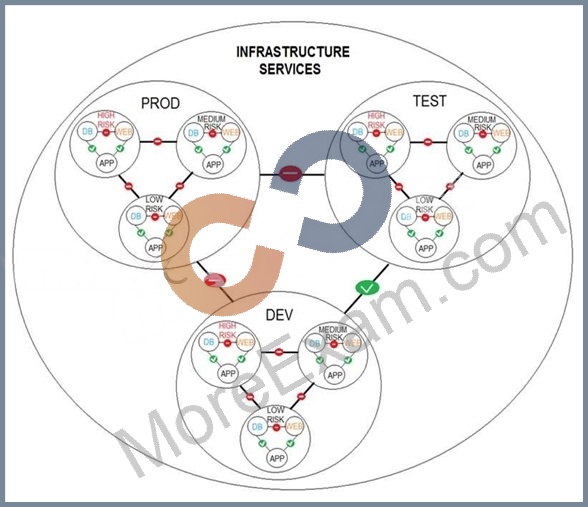
Question8: Refer to the exhibit.A financial company is adopting micro-services with the intent of simplifying network security. An NSX-T architect is proposing a NSX-T Data Center micro-segmentation logical design. The architect has created a diagram to share with the customer.How many security levels will be implemented according to this Logical Design? (Choose the best answer.)
Question9: A customer has a requirement to implement a next generation firewall (NGFW) to improve security network introspection. The customer wants to apply the NGFW to all workloads exposed both internally and externally.The customer wants the NGFW to work seamlessly with NSX-T Data Center and vSphere.Which solution should be recommended to the customer? (Choose the best answer.)
Question10: An architect is helping an organization with the Conceptual Design of an NSX-T Data Center solution.This information was gathered by the architect during the Discover Task of the Engagement Lifecycle:There are applications which use IPv6 addressing.Network administrators are not familiar with NSX-T Data Center solutions.Hosts can only be configured with two physical NICs.There is an existing management cluster to deploy the NSX-T components.Dynamic routing should be configured between the physical and virtual network.There is a storage array available to deploy NSX-T components.Which two requirements were documented by the architect? (Choose two.)
Question11: What would an architect recommend to a customer that wants to extend management to an additional data center through Layer 2, but does not want to add additional NSX-T licensing? (Choose the best answer.)
Question12: Which selection is associated with the Review Task of the Engagement Lifecycle? (Choose the best answer.)
Question13: A customer deploying NSX-T Data Center requires role based access controls be enforced in NSX Manager with these requirements:* identity platform must be highly available* authentication must be performed by customer's existing SAML identity provider* MFA must be performed by administrator to gain access to NSX ManagerWhich identity deployments would meet the customer's requirements? (Choose the best answer.)
Question14: An architect is helping an organization with the Physical Design of an NSX-T Data Center solution.This information was gathered during a workshop:Any proposed solution must provide low latency.Any proposed solution must provide high throughput.Customer is running stock trading applications.Which two selections should the architect recommend to meet high-performance workload requirements? (Choose two.)
Question15: A Solutions Architect is working with a customer which wants to extend their traditional Telco IP/MPLS core network to an NFV cloud.Which NSX-T Data Center feature can be recommended by the architect? (Choose the best answer.)
Question16: A customer wants to use ECMP to provide additional throughput and availability for their critical business applications. Some applications require load balancing for scale and availability.Which two Edge design choices can an architect present to the customer? (Choose two.)
Question17: An architect is helping an organization with the Physical Design of an NSX-T Data Center solution.This information was gathered during a workshop:Current hypervisor of choice is KVM.Cost reduction is important.Which two selections should the architect recommend to the organization? (Choose two.)
Question18: An architect is helping an organization with the Conceptual Design of an NSX-T Data Center solution.Which risk is documented by an architect? (Choose the best answer.)
Question19: An architect is helping an organization with the Physical Design of an NSX-T Data Center solution.This information was gathered during a workshop about ESXi Host networking:* A total of 50 ESXi hosts to be configured as Transport Nodes.* All ESXi hosts have a dedicated 2 × Intel 10Gbps Physical Network adapter for the Overlay Traffic.To achieve low latency, high throughput, redundancy, and performance, which two NIC teaming policies should the architect recommend? (Choose two.)
Question20: An architect is helping an organization with the Logical Design of an NSX-T Data Center solution.This information was gathered during the Assessment Phase:There is a performance based SLA for East - West traffic.The business critical applications require prioritization of their traffic.One of the services is a file share and has a high demand for bandwidth.Which selection should the architect include in their design? (Choose the best answer.)
Question21: Which two benefits can be achieved using in-band management of an NSX Bare Metal Edge Node? (Choose two.)
Question22: An architect is helping an organization with the Logical Design of an NSX-T Data Center solution.This information was gathered during the Assessment Phase:* Maximum performance and availability is required between the physical and virtual network.* Load Balancing service is required for back-end web servers.* NAT is required.Which selection should the architect include in their design? (Choose the best answer.)
Question23: Which type of design includes vendor models, host names, IP Addresses, port connections, logical unit number sizes, and number of CPUs? (Choose the best answer.)